Ajuste e atrito
Everything we know about why sandals rub
This page exists because the honest answer to “will they rub?” is not “no”. It is: here is where, here is why, here is how long, and here is what reduces it.
Everything below is repeated in the specific form on each product page. Nothing here is a substitute for reading the numbers on the pair you are considering.
Last updated 15 August 2026
Why does the top of my foot get pressed, and why does a bigger size not help?
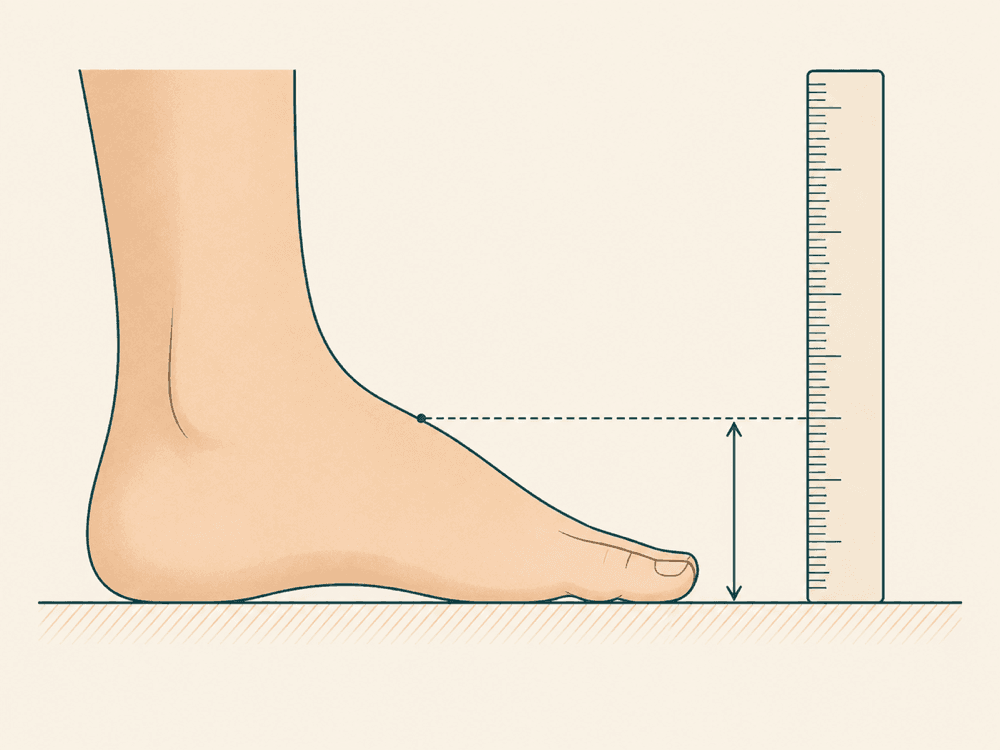
Because the strap is crossing the highest point of your foot and the opening it forms is shorter than that height. That is a vertical problem, and shoe sizes are a horizontal measurement.
Going up a size makes the sandal longer, not taller. It will not fix a tight instep — the strap anchor points move forward, not upward.
So we publish a maximum instep height in millimetres for every style, and a strap travel in centimetres wherever the style adjusts. Measure once with a ruler — the four-step guide is here — and the guessing stops.
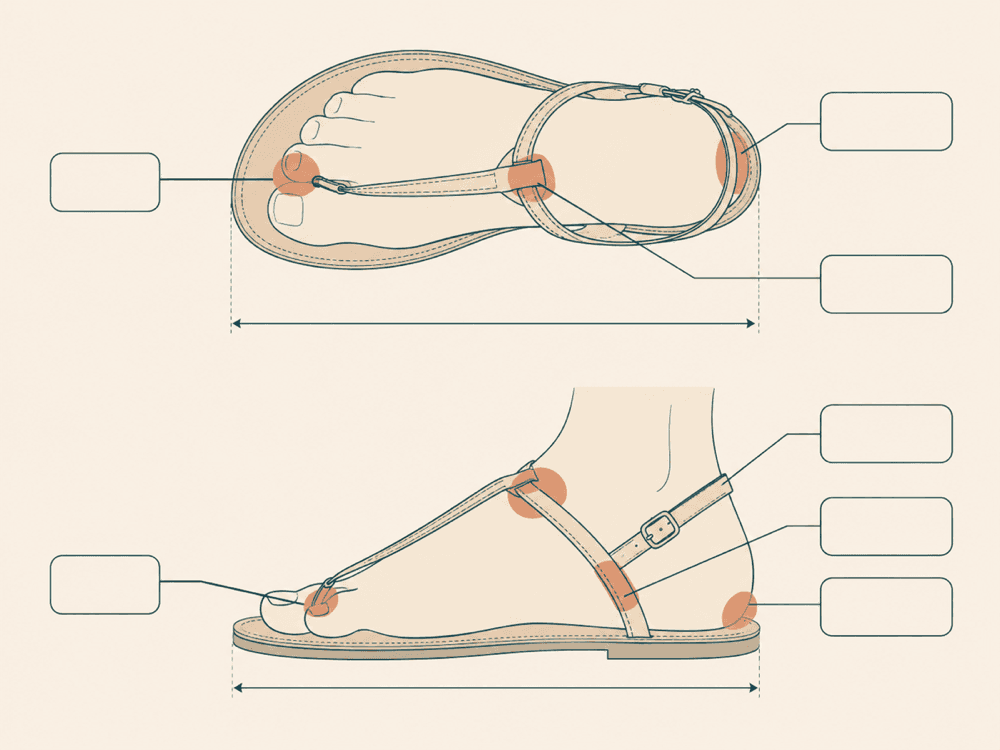
Where can an open sandal rub?
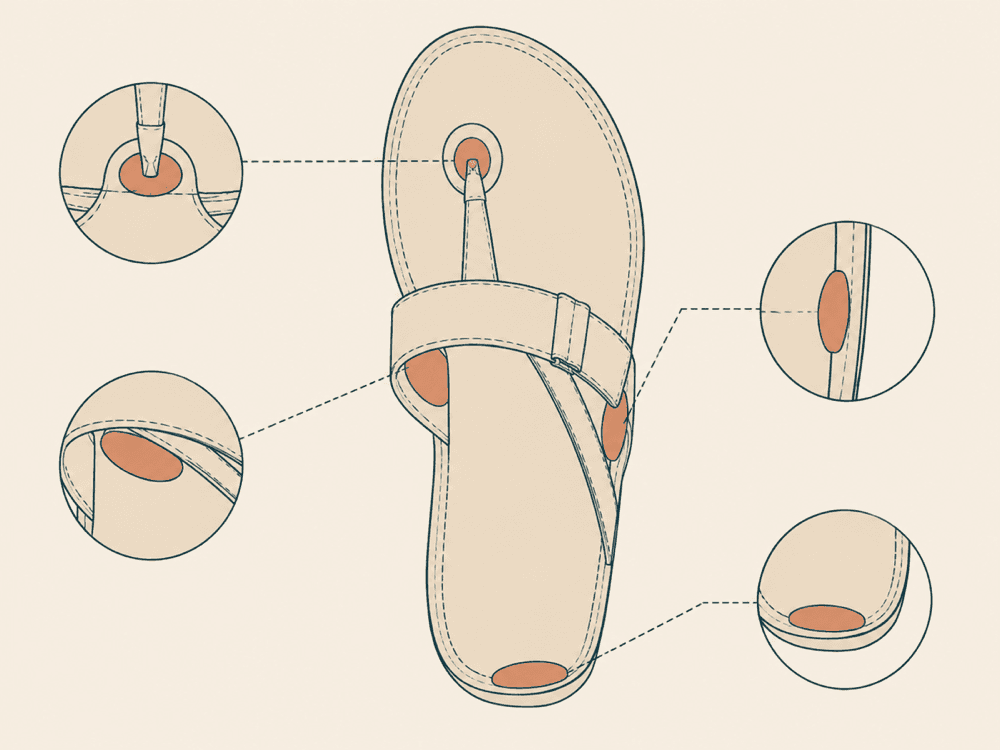
Four places, and which ones apply depends entirely on the structure:
- Between the first and second toe. Toe-post styles only. The skin fold there has almost no callus, sweat softens it further, and the post moves against it with every step. A padded post sleeve widens and rounds the contact surface; it does not remove the post.
- Along the back heel edge. The rear rim of the footbed meets the heel at an angle while the leather is still firm. It rounds off with wear. An oval pad on the rim — not on your skin — carries the first week.
- Across the top of the instep. The strap sits under tension on the highest point of the foot. If your instep is near the top of a style’s published range, this is where you will feel it, and no amount of break-in creates height.
- At the outer side opening. With nothing enclosing the side of the foot, the foot travels sideways on the bed and the little toe meets the rim. Tightening the forefoot strap by one hole usually stops it.
How long does break-in actually take?
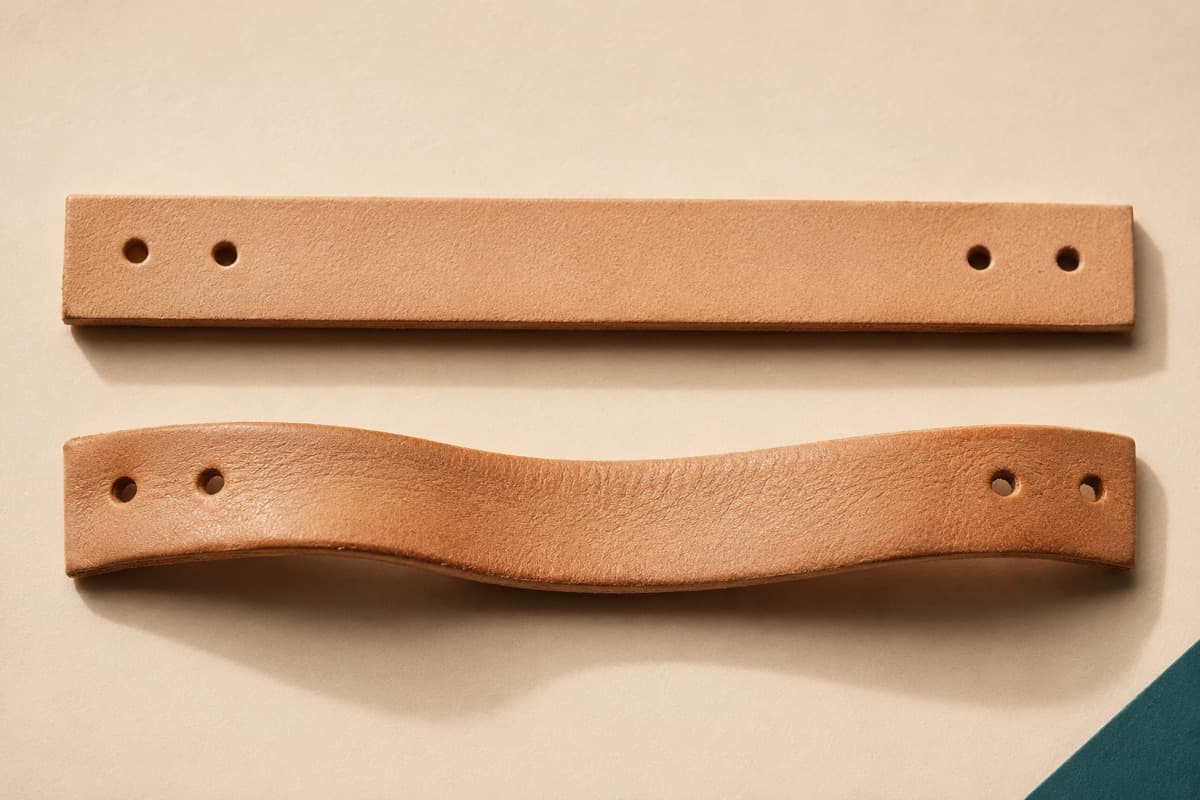
For most leather straps, three to five wears. For a wide band or a woven upper, four to six, because there is more material to soften. Elastic needs none at all — and cannot be tightened later, which is the trade-off.
Keep the first wears short and indoors. Leather takes the shape of the foot it is on, so the first hours matter more than the next twenty.
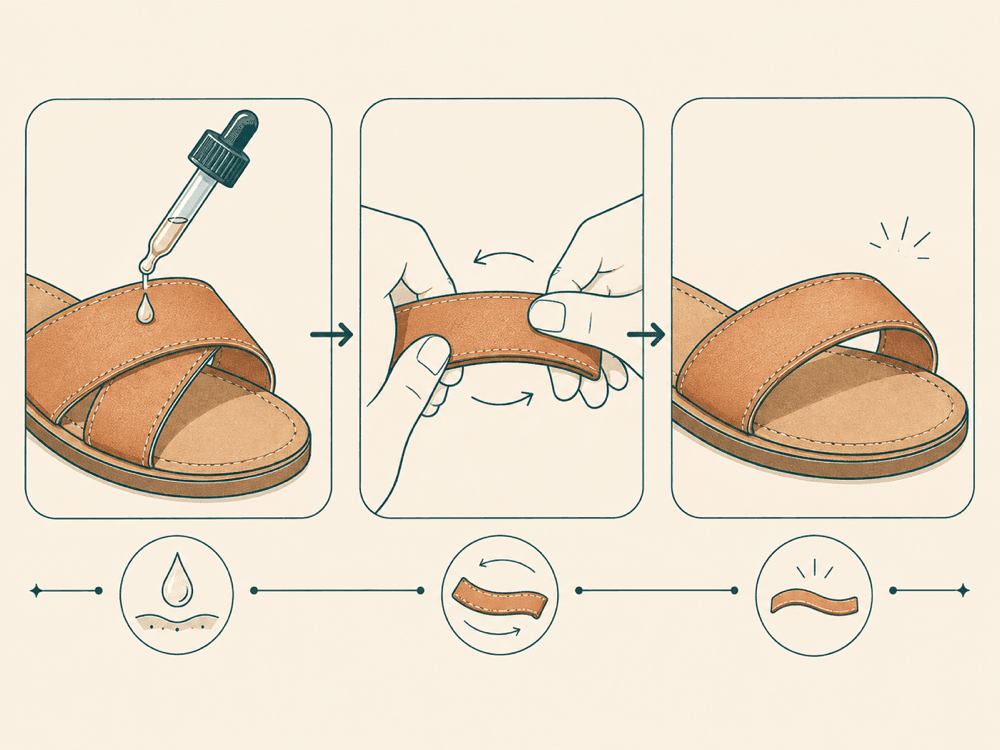
A softener shortens the process; it does not skip it. Work it into the strap, flex the strap by hand, and let it dry away from heat.
What does wearing them barefoot do?
The footbed takes sweat directly, all day. Two consequences, both manageable and both worth knowing before you buy.
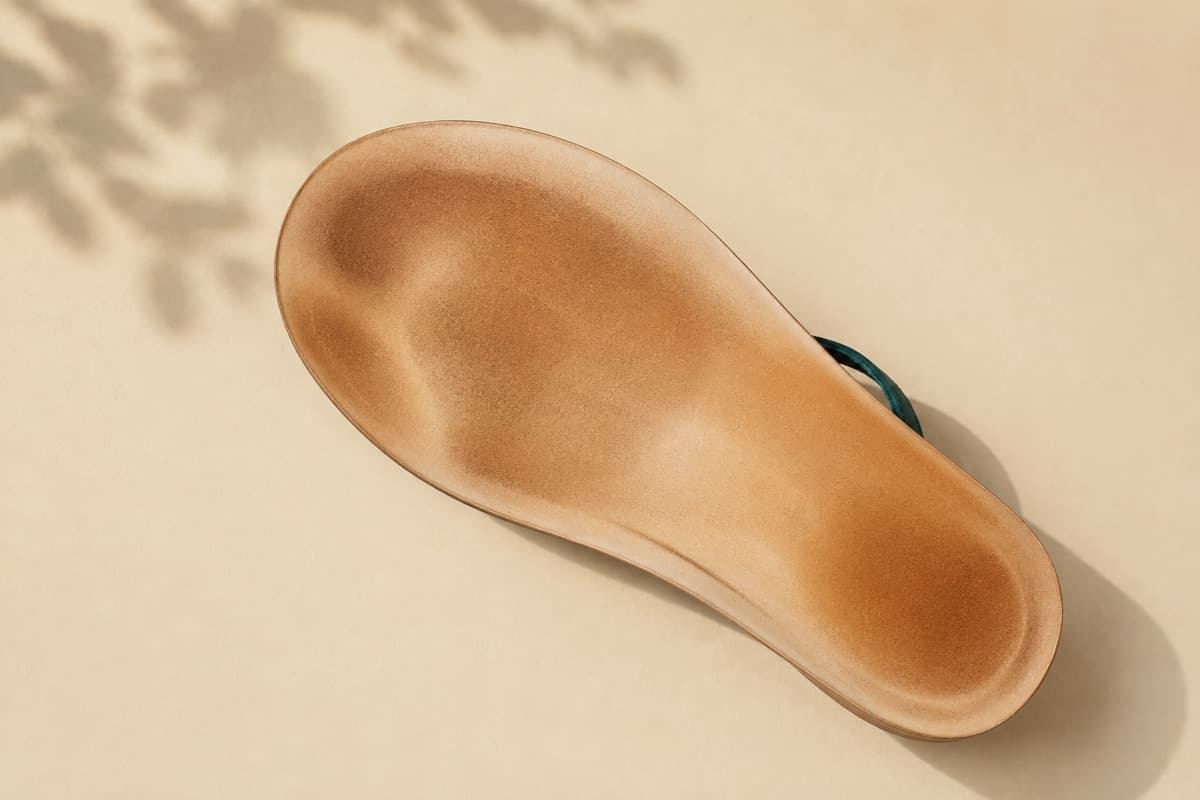
The leather darkens where the ball of the foot and heel sit. That is patina. It is a characteristic of unfinished leather, it is uneven by nature, and it is not a fault.
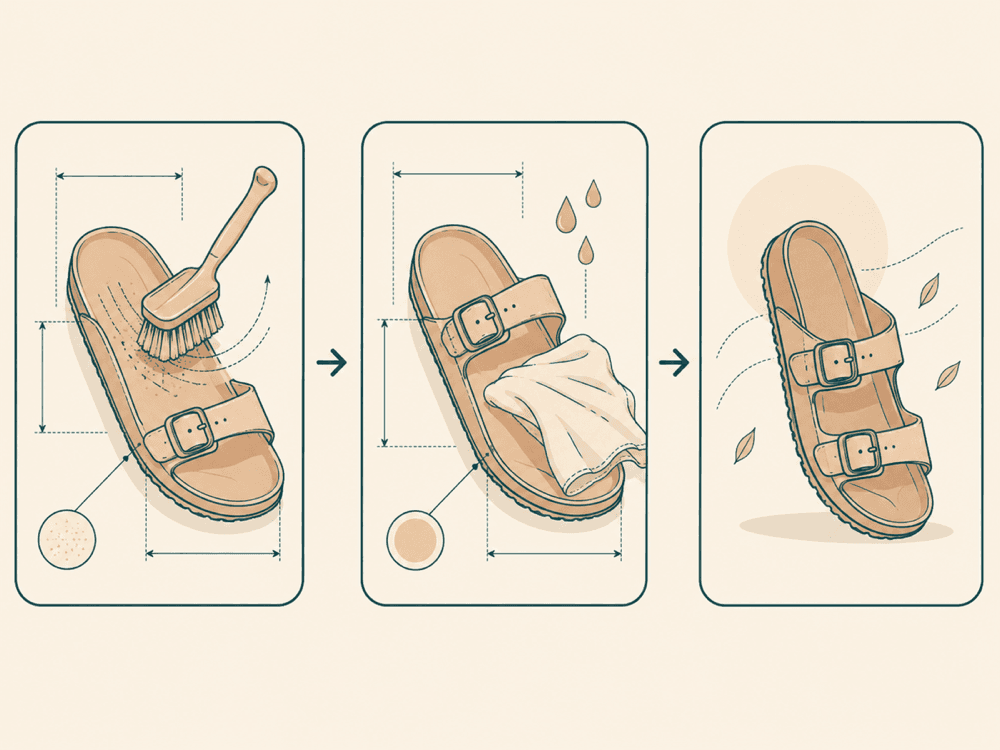
Odour builds if the bed never dries. Wipe it with a barely damp cloth after each wear, let it dry away from direct sun and never on a radiator, and alternate pairs in hot weather. In high summer, use the footbed cleaner once a week.
So when is rubbing a defect, and when is it not?
This is the distinction that decides claims, so it is written the same way here and on the guarantee page.
Not a defect. Friction during the break-in window described on the product page. Patina on a barefoot footbed. A style pressing on an instep taller than its published maximum. Sole wear from walking. Colour change from sun, salt water or sun cream.
A defect. A strap that snaps or tears. A buckle pin that bends or a frame that breaks in normal fastening. Stitching that opens. A footbed that lifts from the midsole, or an outsole that separates. A toe-post that pulls out of the bed. Adjustment holes tearing through. A pair that does not match the numbers we published.
Two worked examples. A strap rubs at week six: break-in is over, so we check whether the strap has stretched past its stated range — if it has, defect; if the pair still measures as published, it is a fit mismatch and the withdrawal period or a different structure is the answer. A toe-post feels sharp from wear one: a post with a missing sleeve or a moulded ridge is a defect; a bare post simply being present between the toes is the design, and the product page says which one you are buying.
Where a case is genuinely on the line, we decide in your favour. Write to support@artshoespt.mom with two photographs.
How do I read the three material rows?
Footwear sold in the European Union has to declare three parts separately — the upper (parte superior), the lining and insole (forro e palmilha), and the outsole (sola) — each as leather, coated leather, textile or other materials, with the matching pictogram.
For open footwear the middle row is the one people misread. With no enclosing lining, that row is effectively describing the footbed you stand on, which is exactly the part that matters for barefoot wear. We give the specific material as well as the legal category, so “other materials” never has to be taken on trust.
Where one material makes up 80% or more of a part, only that material is declared. Where none does, we declare the two main ones. And a word we do not use loosely: couro appears only where the part is genuinely hide.
Some footbeds are described as contoured. What does that mean here?
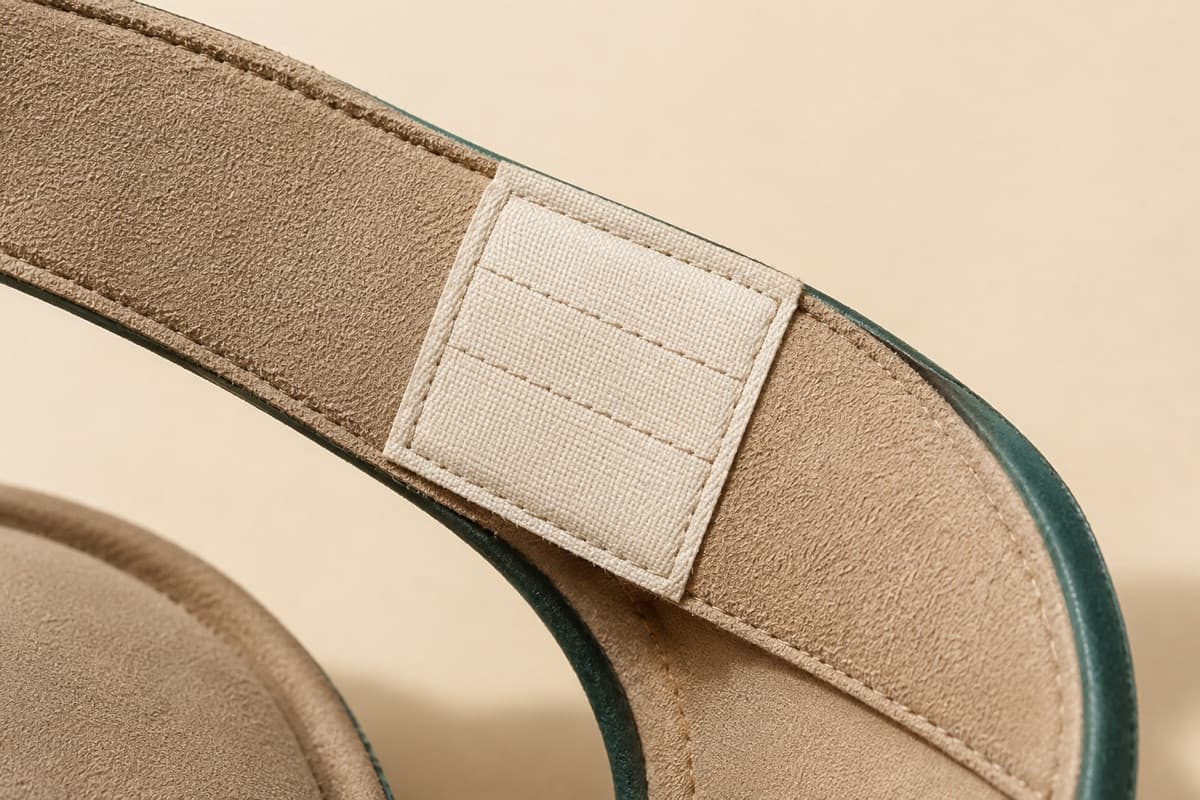
It means the bed is not flat: it rises by a stated number of millimetres under the arch and cups slightly at the heel. That is a geometric description of a shape, and it is the only kind of statement we make about it. We do not claim it supports anything, corrects anything or relieves anything — those would be claims about your body, and a footwear company is not in a position to make them. If something about your feet concerns you, that is a conversation for a health professional.
Care items are cut and formulated for the specific points described above: anti-rub pads, strap softener and footbed cleaner. None of them is required, and none of them will make a sandal taller than its published instep ceiling.
Contactos: support@artshoespt.mom · +351 227633200 · Rua dos Valos n.º 251, 3700-864 Romariz, Portugal
ARTSHOES - INDÚSTRIA DE CALÇADO, LDA · Governed by Portuguese law. Contact form